Voiceflow
A real-time AI voice assistant for automated food ordering, built entirely locally with wake-word detection, MCP tool integration, and intelligent voice-driven workflows.
“Sometimes you gotta run before you can walk.”
- Tony Stark, Iron Man (2008)Ayush Tripathi is an AI agent and backend engineer from IIT (BHU) Varanasi, building LangGraph multi-agent systems, RAG pipelines, and FastAPI backends.
“Tony Stark was able to build this in a cave! With a box of scraps!”

I got into programming in class 8 through Java, not because I had a plan, but because it was the first time a computer course felt like a superpower.
That curiosity survived a 2 GB laptop, an ambitious attempt at Android Studio, a few crashed emulators, a JEE detour, and more experiments than sensible hardware should have allowed. It eventually led me through Python, Web3, backend systems, Go, Rust, and now applied AI.
Today, I build products at the intersection of agents, infrastructure, and user experience. I still like moving quickly. I just care more about whether what I ship keeps working when real people depend on it.
Installing Android Studio on a 2 GB RAM computer and crashing emulators taught an early, practical lesson: ambition and available memory are not the same thing. The constraint didn't end the interest; it taught resourcefulness.
Things I built to make difficult workflows simpler, faster, or more reliable.
A real-time AI voice assistant for automated food ordering, built entirely locally with wake-word detection, MCP tool integration, and intelligent voice-driven workflows.
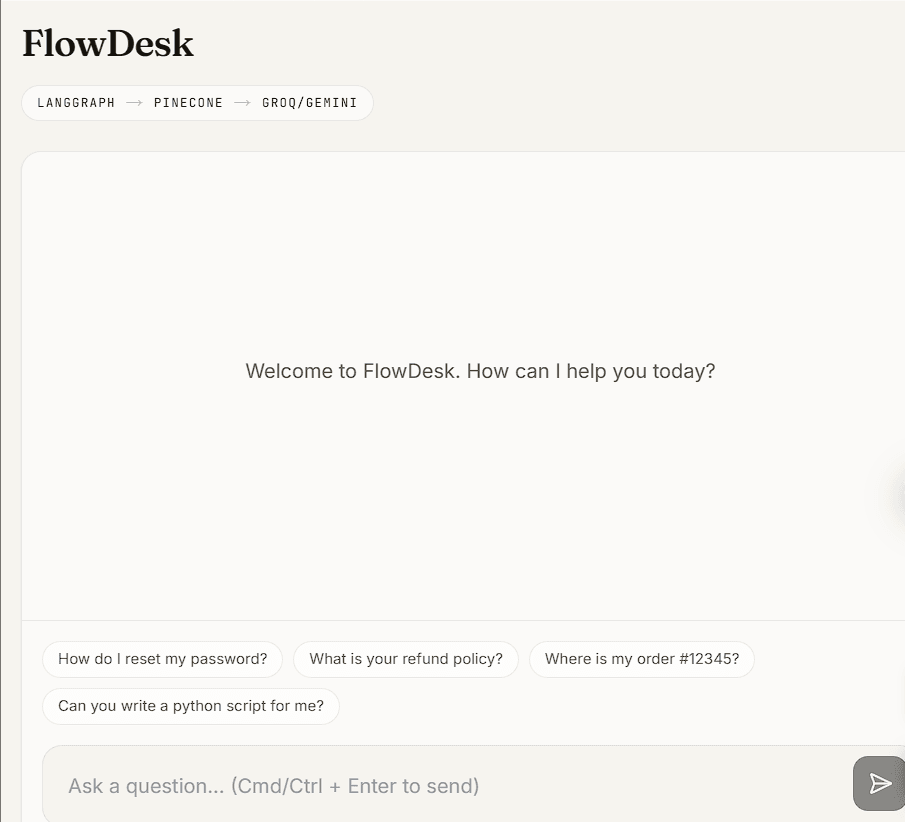
An intelligent, multi-agent customer support platform built with LangGraph, hybrid RAG retrieval, and multi-model routing (Groq Llama 3 + Google Gemini). FlowDesk automatically classifies customer intent, retrieves relevant documentation, generates grounded answers with confidence scoring, and seamlessly escalates to human agents when necessary

What I am learning about agents, infrastructure, product decisions, and the messy work between an idea and a reliable system.
Exploring low-latency streaming turn-taking, open-weight local inference, and Model Context Protocol tool routing.
Investigating structured agent supervisor patterns, citation grounding thresholds, and failure-recovery boundaries.
Studying CRDT-based state reconciliation for autonomous agent swarms and tree-sitter AST queries for code generation.